


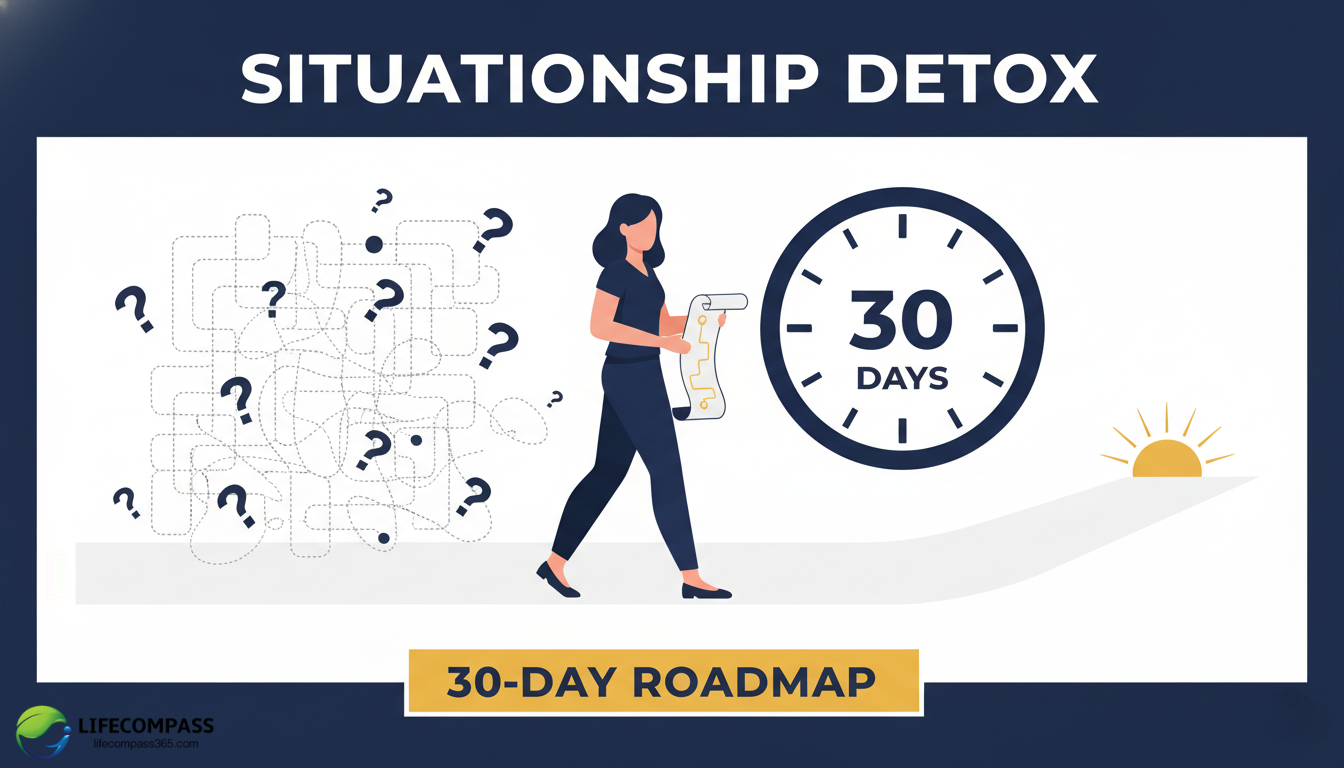
Are you stuck in a “label-free” zone where affection is present but commitment is absent? Feeling exhausted from waiting for a text or constantly wondering “what are we” is a universal signal that you need a Situationship detox immediately. This isn’t just about stopping communication; it’s a mental purification process to reclaim the self-esteem that has been quietly eroded.
The Psychology of the “Almost” Relationship: Why It’s So Addictive
Before starting the detox, it is essential to understand the root cause of why these relationships are so addictive. A situationship is essentially an “intermittent reinforcement” trap. Because you only receive rewards like affection or attention occasionally and unpredictably, your brain stays in a constant state of craving. This cycle taps into basic human needs for connection and control. You are trying to acquire a commitment that doesn’t exist to satisfy the need for a bond. When the bond is inconsistent, the brain treats it like a gambling addiction. The Situationship detox is designed to break this chemical dependency.
In the modern dating landscape, especially within the US market, situationships have become a “soft constraint”—a human convention that many accept as the norm, even when it causes significant distress. You might tell yourself that being “chill” or “flexible” is a sign of maturity, but if it violates your internal “Reference Frame” of peace and clarity, it is actually a systemic issue that needs addressing.
The Biological Reality of the “Situationship Hangover”
During the first seven days of your Situationship detox, you aren’t just fighting a “crush”; you are fighting a biological withdrawal. Your brain has become accustomed to the “breadcrumbing” effect—receiving just enough affection to keep you hooked but never enough to feel secure. This creates a neurological feedback loop where your self-worth becomes tied to external validation.
The withdrawal manifests as physical anxiety, an obsessive need to check your phone, and a distorted memory that filters out the bad times and highlights the few good moments. To survive this, you must treat your phone as the primary delivery system of your “addiction”. Every time you view their social media story, your brain receives a micro-dose of cortisol followed by a frantic search for dopamine.

Why Traditional Breakup Advice Fails for Situationships
Most people fail because they choose the “Fake Road”: trying to remain friends or seeking a logical explanation from the other person. In an undefined relationship, the lack of closure triggers a toxic Dopamine loop.
- The Harsh Truth: Seeking “Why?” only leads to deeper self-doubt. You must learn how to stop doubting yourself to realize that the ambiguity itself is the answer.
- The Consequence: You waste energy on someone who treats you as an option instead of building your own core strength.
- The Illusion of Closure: We often think we need one last conversation. In reality, their lack of effort is the closure.
Traditional advice often suggests “getting back out there” immediately, but this ignores the “Root Cause” of why you entered a situationship in the first place. Without a proper Situationship detox, you are likely to repeat the same insecure patterns and end up with the same negative results in your next relationship.
Phase 1: Survival and The “Cold Turkey” Strategy (Days 1-7)
To truly escape, you must choose the “Real Road”: the Cold Turkey principle. This is where you apply resilience to protect your self-worth.

- Insight – Why Total Cut-off?: Human behavior stems from the drive to defend mental safety. By maintaining contact, you keep the door open for new wounds. You must recognize toxic behaviors you should walk away from to protect your peace.
- The “Halo Effect” Strategy: Borrow strength from those who have mastered self-discipline. Think of high-achievers who prioritize their time; they wouldn’t let a low-effort dynamic drain their energy.
- 💡 Quick Win: Right now, perform a 5-minute digital declutter. Archive conversations or delete photos. This is a core step in how to break a bad habit.
Implementing the “Digital Barrier”
In the first week of your Situationship detox, your goal is a neurological reset. If you cannot delete them yet, you must at least “mute” and “restrict” their accounts so their name never appears in your feed. This is a critical adjustment in your environment that leads to massive shifts in your results.
- Action: Deciding not to check their social media is a high-leverage choice that saves mental energy.
- Mindset: Practice self-acceptance to remind yourself that your worth is not defined by someone else’s inability to commit.
The Survival Blueprint
Week one is about survival, not deep analysis. You are dealing with the physical urge to reach out. Your focus should be on how to build self-discipline to override these urges. Every time you resist the urge to text, you are strengthening your internal foundation.
- Morning Routine: If you used to text them every morning, your “morning routine” is now a trigger. You must actively replace this with a new habit, like a short walk or reading, to “reset” your brain’s expectations.
- The 5-Minute Rule: If you feel like you are about to relapse, tell yourself you will wait 5 minutes before acting. During those 5 minutes, engage in a different task or look at self-inspirational quotes to shift your mental state.
By the end of this first stage of your Situationship detox, you will have achieved the most difficult part: breaking the immediate cycle of dependency.
Phase 2: Cognitive Restructuring and Navigating “The Void” (Days 8-20)
As the initial panic of withdrawal from your Situationship detox begins to fade, it is often replaced by a heavy, lingering sadness or a profound sense of “the void”. This is the most dangerous stage for a relapse because your brain, starving for its accustomed chemical hit, will attempt to negotiate with you. It will filter out the inconsistency and the nights you spent crying, and instead, it will highlight only the “peak” moments of the connection.
To overcome this, you must apply deep observation to your own behavioral patterns rather than being a victim of them. This phase is about transitioning from emotional reaction to logical analysis.

Applying the Observation Framework to Loneliness
Instead of reacting to the pain by reaching for your phone, observe it as an objective scientist using the OAS Framework (Observation – Analysis – Synthesis):
- Observation: Identify the exact environment and time that triggers your urge to reach out. Is it Sunday evening when your schedule is empty and the house is quiet? Is it after a stressful day at work when you crave a quick hit of validation?
- Analysis: Realize that your desire is often triggered by the context of boredom or stress, not the specific qualities of the person. You miss the idea of companionship and the ritual of being wanted, not the individual who consistently refused to commit to you or respect your needs.
- Synthesis: Conclude that the “Almost Relationship” was an imaginary constraint on your true happiness and potential. Recognizing these toxic behaviors you should walk away from helps you realize that the “void” is actually a necessary space for your personal growth.
Breaking the Habitual Loop
In this stage of the Situationship detox, you must actively replace old patterns with new, high-value rituals to “reset” your brain’s expectations. This is not just about staying busy; it is about intentional habit replacement. If the silence becomes overwhelming, reviewing how to practice mindfulness can provide the mental stability needed to stay the course without relapsing into old behaviors.
Phase 3: Reconstructing Your Identity and Future-Proofing (Days 21-30)
The final stage of the Situationship detox is about building a “Growth Mindset”—shifting your self-narrative from “I am not enough for them” to “I am too valuable for a half-hearted love”. This requires you to pivot your energy away from external validation and toward your internal drives to LEARN and CREATE.

Strategic Leverage for Personal Sovereignty
True recovery involves taking the 10-20 hours a week you used to spend worrying about them and reinvesting it into high-leverage goals.
- 1 Arrow → N Targets: Apply this leverage strategy by choosing actions that achieve multiple goals simultaneously. For example, starting a challenging fitness program builds your physical health (Target 1), serves as a stress-relief mechanism (Target 2), and builds the self-discipline needed to maintain your boundaries (Target 3).
- The Power of Consistency: Success in healing comes from the power of consistency in honoring your own standards. By the end of thirty days, your goal is to have built such a strong “Core Essence” that you are no longer a psychological match for low-effort dynamics.
Dealing with the “Relapse” Mindset and the “Closure” Myth
In modern dating culture, there is an obsession with “having a talk” to get closure. However, a core principle of the Situationship detox is that true closure is 80% an internal transformation. You do not need their permission, their explanation, or their apology to be healed.
Their inconsistency, their mixed signals, and their refusal to choose you ARE the only closure you need to move forward. If you feel weak during this final stretch, return to the practice of self-acceptance to remember that your worth is inherent and was never up for negotiation in the first place.
Analyzing the Cause and Conditions
To ensure this Situationship detox sticks permanently, you must analyze why you were susceptible to this dynamic initially:
- The Cause: This often stems from an internal belief that love must be earned through struggle or that you are not smart enough to unlock your true potential alone.
- The Conditions: These are external factors like staying up late, having no clearly defined personal goals, or keeping distractions like dating apps available when you are vulnerable.
- The Result: If the cause and conditions remain the same, you will inevitably end up in another situationship.
By changing the conditions—deleting the apps, setting a strict sleep schedule, and focusing on your career—you inevitably change the result of your future relationships. Small changes in your environment (Kaizen) lead to massive, exponential shifts in your life’s outcomes.
Situationship Detox Checklist: The Final Action Plan
To ensure your results are measurable and sustainable, follow this final checklist:
| Phase | Strategic Action | Timeline |
|---|---|---|
| Survival | Complete Digital Declutter & “No Contact” | Immediately |
| Analysis | Map the “Contexts” and triggers using the OAS Framework | Days 8 – 14 |
| Reconstruction | Implement one high-leverage personal goal unrelated to dating | Days 21 – 25 |
| Sovereignty | Finalize your “Growth Mindset” review and celebrate your autonomy | Day 30 |
Advanced Resilience: The “5-Minute Rule” and Beyond
If you face a sudden obstacle or a moment of intense craving for their validation, apply the “5-Minute Rule”. Tell yourself you will wait exactly five minutes before taking any action. During that window, engage in a task that requires your full focus—researching a new skill, organizing your workspace, or reviewing your progress. Most emotional urges are like waves; if you can stay on your “Road” for five minutes, the peak will pass, and you will remain in control.
The Final Transformation: Achieving Emotional Sovereignty
Completing a Situationship detox is the ultimate act of self-service and leadership. By the end of these 30 days, you will realize that the most important relationship you have is the one you have fostered with yourself. You have moved from the “Fake Road” of seeking external validation to the “Real Road” of authentic self-sovereignty.
You are no longer an “Underdog” waiting for someone to notice your worth; you are the architect of your own happiness. Within the next 24 hours, identify your “Drill Point”—the one remaining digital habit or mental assumption keeping you tethered to the past—and cut it today to finalize your journey toward emotional freedom.

Strategic Integration: The Path Forward
Your journey does not end at day 30; it simply evolves. Use the time and clarity you have gained to build reusable assets in your life—stronger friendships, better professional habits, and a deeper understanding of your own needs. This is how you do the work once and reap the benefits for a lifetime. You are now equipped with the intelligence leverage to identify mixed signals early and the self-discipline to walk away before your peace is compromised.


Leave a Reply